Personality AI is a technology that analyzes millions of online data points to identify someone’s personality before you ever meet them. Crystal first brought it to market in 2015 as a button inside LinkedIn. In 2026 it also runs inside AI agents, through the Crystal Personality API and MCP server. This guide covers what it is, how it works, why it beats asking a chatbot, and how to use it yourself or in software you build.
Table of contents:
- What is Personality AI?
- How Personality AI works
- Why not just ask ChatGPT?
- Personality AI for AI agents: the Personality API
- How to use Personality AI
- Why it matters: attention is the scarce resource
- How to get started
What is Personality AI?
Personality AI takes multiple types of inputs, such as text samples, demographic data, real-life observations, and questionnaire responses, and outputs personality insights: how a person makes decisions, how much detail they want, what earns their trust, and what turns them off.
At our company, Crystal, we first brought Personality AI to market in 2015. Since then, early adopters have used it for millions of emails, meetings, and phone calls, with results they often describe as “magic.” The magic moment is usually the first time someone clicks the Crystal button on a LinkedIn profile and immediately sees how that person communicates.
While I’d like to claim our team attended Hogwarts, Personality AI is not actually magic.
It’s a convergence of technology, psychology, and personality theory to help us understand how to communicate with anyone effectively.
How Personality AI works
Artificial Intelligence is a technology that can analyze massive volumes of data to predict potential outcomes. When we make decisions, our brains quickly process our past experience and knowledge to reach a conclusion. AI is similar, but it is a brain that can be loaded with a tremendous amount of “past experience” (data) to make better predictions. Personality AI, specifically, is best thought of as a machine with inputs and outputs.
Crystal’s model has two parts. The first is a proprietary dataset of hundreds of thousands of anonymized personality assessment results, which tells the model what real DISC profiles actually look like. The second is the analysis of publicly available information about a person: job titles, industries, work history, skills, interests, recommendations, and the way they write about themselves. The model maps the second onto the first and returns a validated DISC type and archetype, with confidence checks that hold back a prediction when the evidence is thin. You can read more on our how predictions work page.
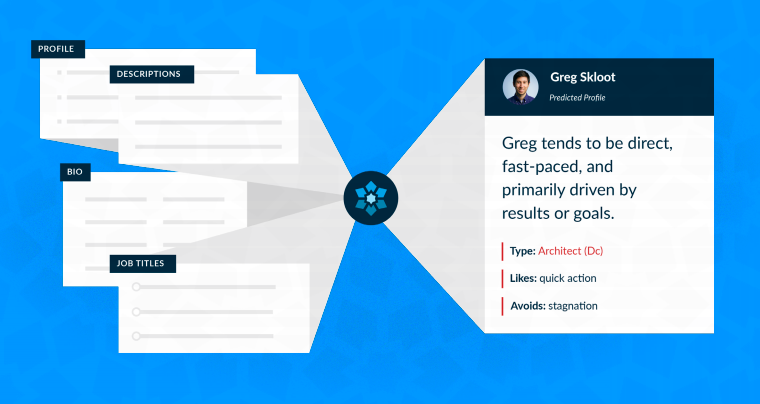
For most people, the value is in the output. Personality AI can tell us, for example, that a coworker appreciates research and accuracy before we ever meet him, so we walk into the first conversation with data ready instead of learning it the hard way over six months.
Why not just ask ChatGPT?
This is the question I get most often now. Large language models are fluent about personality. Paste someone’s LinkedIn profile into a chatbot and it will happily produce a confident DISC type. The problem is that fluent and true are different things. A general model has no dataset of real assessment results to check itself against, so it guesses, and it guesses most confidently exactly where the evidence is thinnest.
We measured this. On the tricky spots that psychometricians care about, where two traits are close or a profile contradicts itself, Crystal’s validated predictions handled 70% of cases; the best raw frontier model handled 56%, and the rest landed lower. The full methodology and per-model results are on our accuracy benchmarks page. The short version: Personality AI is not a prompt. It is a prediction model trained on real assessment results, with checks that stop it from inventing a type when the data is ambiguous.
Personality AI for AI agents: the Personality API
For a decade, Personality AI was something a person looked at before writing. In 2026 most of the writing is done by software. Sales teams run AI SDRs, recruiters run sourcing agents, support teams run assistants that draft replies, and every one of them writes to people with no idea who those people are. They know the account, the job title, and the intent signal. They do not know that the buyer is a D who wants the bottom line in the first sentence, or a C who will ignore any claim without a number behind it.
That is the gap the Crystal Personality API fills. It gives agents and workflows the same people layer our customers have used for a decade, in the form software can call:
- Resolve a person from an email address or LinkedIn URL and get their profile: a validated DISC type and archetype plus concrete communication guidance on pace, detail level, what builds trust, and what creates friction.
- Get the playbook for that person: a selling-to guide, communication advice, and a relationship matrix for a whole meeting of attendees.
- Adapt the output, not just the data. Send a drafted email and get it revised for the reader, or ask for a personality-tuned prompt you can drop into your own model. The prompt endpoint is free.
- Connect it to your assistant. The Personality MCP server plugs into Claude, ChatGPT, Microsoft Copilot, Cursor, and any MCP-compatible agent framework, so profiles, selling playbooks, email rewrites, and meeting prep become tools your assistant calls in the middle of a task. Claude Code users can install the official plugin in two commands; it includes pre-meeting and transcript-analysis skills.
If you build sales, recruiting, or customer tools, this is the version of Personality AI to start with. The Personality API page has the endpoint list, credit-based pricing, and the MCP connection details.
How to use Personality AI
For individuals, Crystal uses a Chrome Extension that adds a “View Personality” button to LinkedIn, Gmail, Salesforce, and other platforms you use before contacting a person. Click it and Crystal analyzes the page, combines it with other collected data, and shows you the person’s personality along with how to communicate with them. It looks like this:
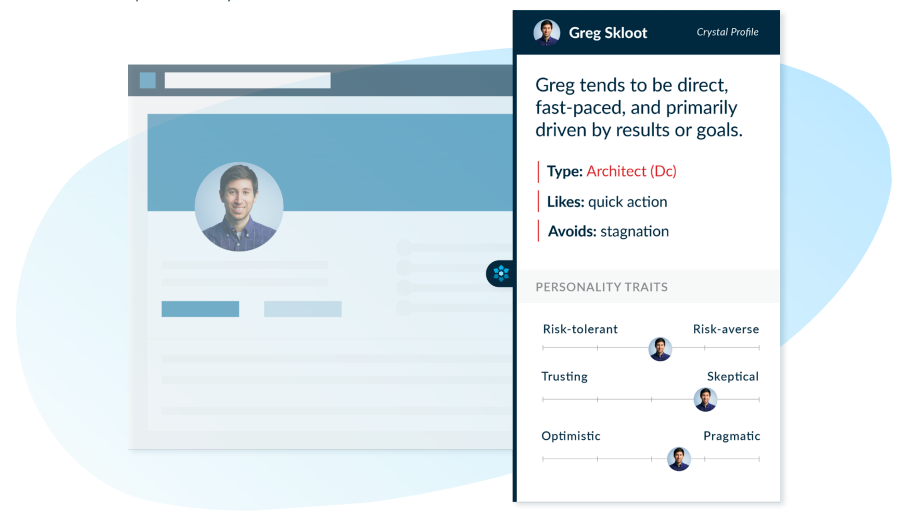
If you already work inside Claude, ChatGPT, or Copilot, the fastest path is the Personality MCP server: connect it once and your assistant can look people up, pull their playbook, and rewrite your drafts without you opening another tab.
Three things get easier once you have that in front of you.
Communicate more effectively
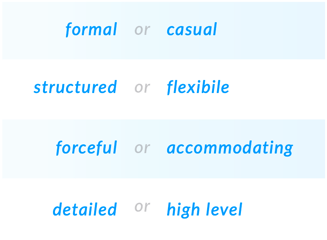
Cutting through the noise is the number one challenge for anyone whose job is talking to people: salespeople, managers, recruiters. Personality AI lets you communicate in a deeply personalized way by recognizing everyone’s differences. If we know a person appreciates formality and structure, we are not going to succeed by calling them unscheduled and inviting them for coffee. A well-written email asking permission to send more information will do much better. Communicating in the right style often means the difference between a “click,” where both people feel understood, and a wall.
For example, it can tell us if someone is:
Write more persuasively
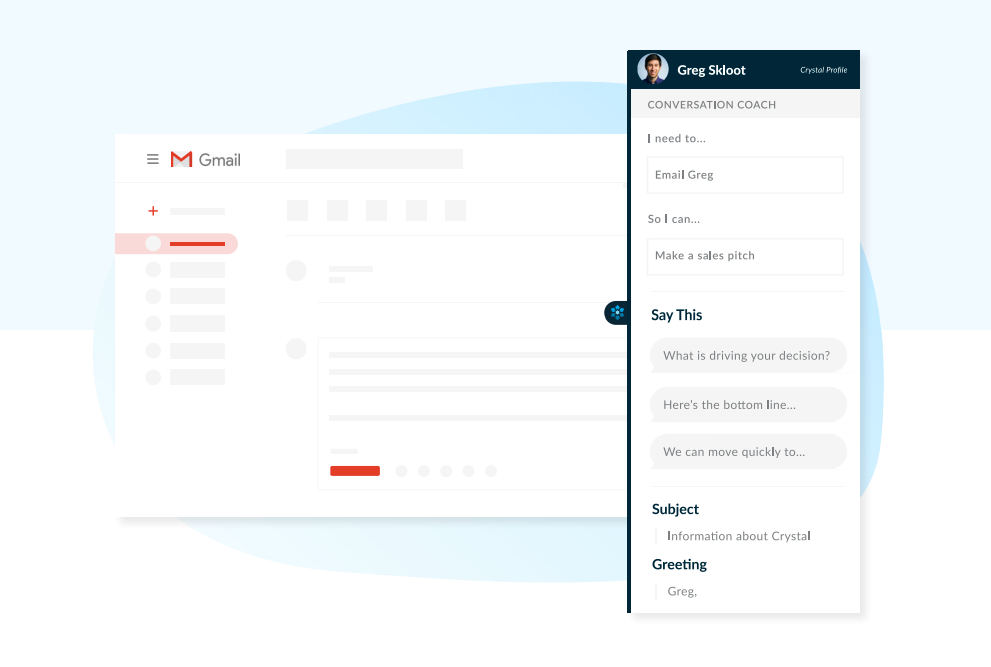
A significant portion of professional communication happens in writing, and we only read the emails that truly appeal to us. Everything from the subject line to the length can resonate, or turn someone off, based on their preferred style. Once Personality AI has identified someone’s personality, you can customize an email to:
- Have a subject line that increases open rates
- Be the right length and not lose attention
- Include the right details and social proof
- End with the right call to action that motivates the reader
Build trust faster with new people
With coworkers we build trust slowly, by learning each other over months. That is fine for long-term relationships, but it is not nearly fast enough for prospects, candidates, or customers. The right way to build trust depends heavily on personality. If you like to share personal details, you might read someone more guarded as cold; they might read your questions as a violation of their space. Neither is wrong. If you know in advance that someone is guarded, you adjust, and the friction never happens.
Why it matters: attention is the scarce resource
When people ask me what I do for a living, I usually give the same answer: “I talk to people.” As a leader of a software company, most of my day is pitching prospects, convincing candidates to join, or explaining strategy to coworkers. If you asked a salesperson, recruiter, manager, or consultant the same question, their answer boils down to the same thing.
“Talking with people” has gotten significantly more complex in the last 20 years. Social media, smartphones, and ubiquitous technology made it cheap to reach anyone, and the side effect is that we are all bombarded with so many messages we have to ignore most of them. According to sales advisory firm TOPO, it takes the average sales representative 18 calls to connect with one buyer and 4 emails to get one opened. The common response is to play the numbers game: blast generic messages at the biggest list you can find and wait for a few replies to trickle in. It is impersonal, inefficient, and it is why so much outreach goes straight to the archive.
The Secret Sauce: Empathy
The opportunity in a hyper-skeptical environment is empathy: understanding someone’s motivations, desires, and communication style, and treating them the way they want to be treated. In communication, the Golden Rule does not quite apply. We all have our own preferences, and our recipients may be very different. Instead of assuming they want the same type of email, meeting, or conversation we do, we do much better by understanding how they want to be treated. In other words, we need to know their personality before we can communicate effectively.
Historically, understanding someone’s personality without meeting them was nearly impossible unless you could ask people who knew them or convince them to take a test. Personality AI removes that constraint, for people and now for the agents that write on their behalf.
How to get started
Earlier in my career, my business partner Drew and I hired a management coach who taught us the basics of communicating with others based on personality. Whenever we found ourselves in a tricky situation alone, we wished we could turn to him for advice on how to respond.
Tools powered by Personality AI, like Crystal, become that coach for every conversation. If the conversation is being drafted by an agent instead of a person, the same coach is available to it through the Personality API or the MCP server.
By communicating with others the way they want to be communicated with, you will be more successful in every professional endeavor, from closing more deals to hiring the right people for your team.