
This is Part 4 of our series on Personality Neuroscience.Click hereto read from the beginning.
Over the past few decades, theFive Factor Model (the “Big Five”)has emerged as the most well-validated model of personality traits. As a result, most personality studies today use the Big Five as a foundation.
In 2014, Colin DeYoung published theCybernetic Big Five Theory (CB5T), which views personality as agoal-directed, adaptive system. In this article, we will go through the traits themselves. Later, we’ll cover their neurobiological causes.
The Big Five Explained
The five traits that make up the Big Five are:
Openness
An individual’s ability and tendency to explore and create new experiences, manifesting curiosity, imagination, perception, and creativity.
Conscientiousness
An individual’s ability and tendency to pursue non-immediate goals and follow a set of rules (either self-imposed or imposed by others).
Extraversion
An individual’s ability and tendency to explore, interact, and engage with external rewards (including social, material, and experiential rewards).
Agreeableness
An individual’s ability and tendency to understand the perspectives of others and adjust their behavior to accommodate them.
Neuroticism
An individual’s tendency to experience feelings like anxiety, fear, anger, and panic.
You can remember them in this order with the OCEAN acronym.
The Personality Hierarchy
The Big Five were previously believed to be the broadest dimensions of personality, but as the theory has progressed,researchers have discoveredthat the Big Five traits most likely exist in ahierarchywith twometa-traitsabove them and tensub-traitsbelow.
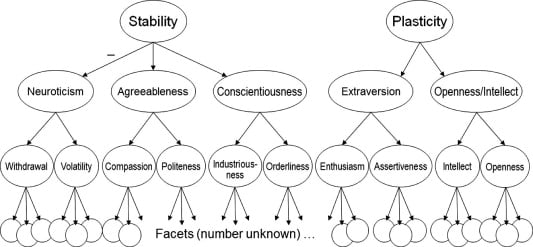
StabilityandPlasticitysit at the highest level of the hierarchy, and they have been found to have almost zero correlation, meaning there are no higher traits.Each of them has been linked to the levels of a specific chemical in the brain...
Stability traits are correlated with serotonin levels.
Serotonin is a neurotransmitter that is known to stabilize information, disrupt impulses, and allow you to focus on goals. High serotonin levels have been associated with low Neuroticism (leading to emotional stability), high Conscientiousness (motivational stability), and high Agreeableness (social stability).
Plasticity traits are correlated with dopamine levels.
Dopamine is a different neurotransmitter that facilitates exploration, learning, and cognitive flexibility. It controls your sensitivity to rewards and potential rewards. High dopamine levels have been associated with high Extraversion and high Openness.
While these two traits are still relatively new discoveries and are still debated among psychologists, the ten sub-traits have been researched extensively and have a big impact on the differences people can experience within the Big Five traits.
Nature or nurture?
According to CB5T, personality traits emerge from bothgeneticandenvironmentalforces. You can probably observe this in your own personality, as you identify the traits that come naturally vs the ones that you’ve picked up from the people around you. The question is…to what extent does each affect your personality?
Unfortunately, we don’t yet know the answer to that question. However, we do havesubstantial evidencethat personality can change drastically over time.
What we know for sure is that everyone has a unique mix of the Big Five traits (and their sub-traits), and that your particular mix is influenced by slight variations in the structure and function of your brain.
Each trait has specific underlying neurobiological causes, and we’re only just beginning to discover them. In the next few posts, we’ll go over what we currently know, trait by trait.